|
Assumption |
|
|
Dear Preachers:
It isn’t often that we get a reading from Revelation in our lectionary selections. If you are like me, you probably haven’t preached from it very much – if at all. Perhaps your biblical reading doesn’t include Revelation as well. Here is a chance to do something about that, so I will focus on the first reading and add some notes I found helpful about this feast.
When I did prison ministry at San Quentin in California, I was struck by how many of the inmates who read the Bible favored the Book of Revelation. What was it that they found so attractive in its exaggerated and stark symbolism – in a biblical book that most Christians seem to avoid? I came to realize they were drawn to its description of the harsh struggle between good and evil that permeates the entire book. They found it comforting to hope that the large punishing system in which they lived, would someday be overthrown along with all the powers of the world. This was reassuring news, both to the early Christians suffering under the Roman persecutions and the men in North Bloc at San Quentin. It is reassuring news for all of us who struggle against the powers of “the dragon” in our world.
Another attraction for the inmates, it seemed to me, was that they believed they knew the code: that they could figure out the symbols and metaphors so prevalent in Revelation. Somehow, they felt part of an inner circle with special knowledge – everyone else was outside that circle. They even used this “knowledge” as a way of feeling superior to those in their same situation. But whatever misinterpretation they may have made of Revelation, you could understand their attraction to this book of visions and prophecies. The book speaks to people suffering under extreme external pressures.
The early Christians, for whom this book was written, were being forced to venerate the Emperor. Not to do so had, not only religious ramifications, but political as well. Christians were asked to choose one Lord to serve – a choice had to be made. If they chose in favor of their Christian belief, they paid for it with their lives. Revelation is not an abstract book of fantastic imagery and other-worldly events. It was written to help Christians remain faithful and to offer reassurance that the Lamb (or as in today’s reading, the child) would be triumphant.
Is it any easier for us to believe and for our faith to flourish? Each day we are confronted by the suffering of our world. Wars continue to drive families from their homes in places such as Ukraine, Gaza, Sudan, and other conflict zones. Millions endure hunger, poverty, and disease without access to adequate food, clean water, or medical care. Natural disasters, violence, and political oppression leave countless people living in fear and uncertainty, wondering where hope and justice will come from." We have to ask the question, “Who is in charge here anyway?” We look around the world and are shocked by the scale of evil we see. Which force will win out? Are we believers on the side that will prevail, or is our seeming-small human effort going to pale into insignificance before the “red dragon with its seven heads and horns”?
Revelation intends to assure us that goodness will win. Like the early Christians we may be tempted to drop out of our faith commitments in the light, allure and power of the opposing forces. Who is the Sovereign we Christians follow? God is and we want, and can, be faithful to the biblical God of justice – the One who will set things right. Revelation then, invites us to set our gaze, not only on our hardships and calamities, but on God. The power of the beast is awesome, its tail sweeps away a third of the stars in the sky. But the child being born is protected by God and will triumph.
While there is no secret code to this book to help us in its interpretation, the language does appeal to our imagination and makes it possible to interpret it in many ways. The struggle is clear and the threat of evil, devouring all that is good, is real and very ominous. A new people, the Christian community, are being born amid great pain and struggle. But despite the threats to its existence, the child is caught by God and is safe. No biblical reader could miss the allusions to the Hebrew scriptures. Just as the God of the Jewish people protected them, so God continues to protect the new people of God. God’s Word is not past tense, but actively protecting and recreating the community for which Jesus gave his life.
The community John has in mind is experiencing extreme hostility. They are being encouraged through this book to trust that God knows their plight and will come to their rescue. Evil shall not triumph. It is no wonder then, that on this feast of the Assumption, this reading is linked to Mary’s “Magnificat.” Mary’s rejoices in the saving work of God, “scattering the proud...casting down the mighty from their thrones....” Here biblical faith, expressed in two different forms, voices the same hope in God. John is not writing a prediction of specific future events, as some today claim, but is trying to encourage and console Christians in his day for their very present suffering. He writes to help them, and us, keep faithful and to assure us that God’s rule and justice will prevail.
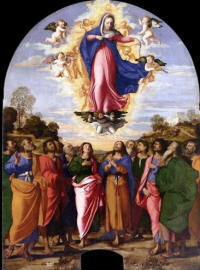
The church celebrates the Assumption of Mary today. We see in her a model for our faith. We too give birth to Christ in our world. We are reminded though Christ suffered, he has been kept safe by God, to whom he has returned and will come to bring us all to that place of protection and life. So, the dragon is not triumphant. The Christian is ready to say in the midst of the battle against evil’s many manifestations, “Now have salvation and power come.” The God of our assurance is offering that assistance to us now in our present struggle.
Click here for a link to this Sunday’s readings: https://bible.usccb.org/bible/readings/081526-Day
This is a complex feast on which to preach. I found some help, some approach for the preacher, from Liturgy Training Publication’s, SOURCEBOOK. I'll quote it in full and hope it offers some insights.
"History of the Solemnity: Soon after the council of Ephesus (431) proclaimed Mary to be Theotokos, the Bearer of God, a feast of her "dormition" or death began to spread. Within a few centuries, the church in Rome began observing this feast, which came to be known as the Assumption. At the first National Synod of the American church (I791), the nation was placed under the patronage of Mary with the title of the Assumption. The cathedral of the diocese of Baltimore, at that time the See for the whole country, was given the same name.
In 1950, Pope Pius XII defined the Assumption as dogma. At that time, he listed the benefits that should flow from this proclamation: a stronger piety towards Mary, a more universal conviction on the value of human life devoted to God's will, a repudiation of the materialism that diverts body and soul from their lofty goal, and "Finally, it is our hope that belief in Mary's bodily Assumption into heaven will make our belief in our own resurrection stronger and render it more effective."
The images of the feast reflect its history. In its earliest form, the day focused on the paschal mystery as expressed in the death of Mary. Making her entrance into heaven explicit was the second stage, with language about a triumphal procession, a bridal march and Mary's bodily assumption later added a third layer of texts for the feast.
Liturgy today: Recent history has focused strongly on the bodily assumption of Mary. The readings for the vigil and the day, however, suggest a stronger focus on Mary's share in the paschal mystery, and on our own share in the same mystery. Planners might review the goals of Pius XII. Have our parish observances of this feast fostered a stronger belief in our own resurrection?"
----Lawrence Mick in, SOURCEBOOK FOR SUNDAY AND SEASONS: AN ALMANAC OF PARISH LITURGY, 1995 YEAR C. (Chicago: Liturgy Training Publication, 1995) page 188.
In the Catholic tradition, responsible citizenship is a virtue; participation in the political process is a moral obligation. All believers are called to faithful citizenship, to become informed, active, and responsible participants in the political process. As we have said, "We encourage all citizens, particularly Catholics, to embrace their citizenship not merely as a duty and privilege, but as an opportunity meaningfully to participate [more fully] in building the culture of life. Every voice matters in the public forum. Every vote counts. Every act of responsible citizenship is an exercise of significant individual power." Even those who are not citizens are called to participate in the debates which shape our common life.
Barbara Molinari Quinby, MPS, Director Office of Human Life, Dignity, and Justice Ministries Holy Name of Jesus Cathedral, Raleigh, NC
Mini-reflections on the Sunday scripture readings designed for persons on the run. “Faith Book” is also brief enough to be posted in the Sunday parish bulletins people take home. From today’s Gospel reading:
Mary said...God has remembered the promise of mercy, the promise God made to our ancestors, to Abraham and his children forever.
Reflection:
In her “Magnificat,” Mary rejoices in the saving work of God, Who “scatters the proud...casts down the mighty from their thrones....” Her prophetic proclamation voices the hope the poor and oppressed have that God has and will raise up people who embody God’s mercy—as Mary’s Son did and as we are called to do.
So, we ask ourselves:
Where and how do I feel called to be a voice for a victimized person or people? What may be holding me back from doing that right now?
POSTCARDS TO DEATH-ROW INMATES “One has to strongly affirm that condemnation to the death penalty is an inhuman measure that humiliates personal dignity, in whatever form it is carried out.” ---Pope Francis
Inmates on death row are the most forgotten people in the prison system. Each week I am posting in this space several inmates’ names and locations. I invite you to write a postcard to one or more of them to let them know that: we have not forgotten them; are praying for them and their families; or whatever personal encouragement you might like to give them. If the inmate responds, you might consider becoming pen pals.
Please write to:
• Reche Smith #0379083 (3/14/2002) • Terrance Campbell #0064125 (3/28/2002)
Central Prison PO Box 247, Phoenix MD 21131 (While the prison is in Raleigh mail for inmates is processed at this address)
For more information on the Catholic position on the death penalty go to the Catholic Mobilizing Network: http://catholicsmobilizing.org
“First Impressions” is a service to preachers and those wishing to prepare for Sunday worship. It is sponsored by the Dominican Friars. If you would like “First Impressions” sent weekly to a friend, CLICK HERE. If you would like to support this ministry, please send tax deductible contributions to:
Fr. Jude Siciliano, OP Holy Rosary Priory 3600 Travis St. Houston, TX 77002-9591
Make checks payable to: Dominican Friars.
Or go to our webpage to make a secure online donation: https://www.PreacherExchange.com/donations.htm
FREE EMAILS:
We have two English email lists available: 1. A preacher's early reflections on the upcoming Sunday's readings and liturgy, always at least one week ahead of the Liturgical Calendar. “A tool to help Preachers prepare for their next trip to the Ambo.” Available in Spanish & English and authored by Fr. Jude Siciliano, OP. 2. Click Here to Sign Up. 2. “VOLUME II” • These reflections follow the Liturgical Calendar and appear here about mid-week each week. They are written by various guest authors. • If you would like to submit a reflection of your own, then Click Here to send it as a “Request to Post” to the Webmaster. Deadline is Monday of each week for the upcoming Sunday.
OUR WEBSITE:
https://www.PreacherExchange.com - Where you will find Preachers Exchange, which includes “First Impressions,” and “Volume 2” as well as articles, book reviews, daily homilies and other material pertinent to preaching and Scripture reflection.
FOR INFORMATION OF “ANY KIND” OR TO MAKE A SUGGESTION: Click Here
(Always includes the 6 latest reflections with the newest first.)
• |
|

























 • Clifford Ray Miller
#0742512 (On death row since 10/25/2001)
• Clifford Ray Miller
#0742512 (On death row since 10/25/2001)


